But Is It Actually Human Enough?
There’s a version of this conversation that goes: AI therapy is dangerous, reductive, and no substitute for the real thing. Close the tab. Move on.
That version isn’t very useful — because millions of people are already using it.
Apps like Woebot and Wysa, along with a growing number of AI-powered mental health platforms, have accumulated users at a scale no therapy practice could approach. And before we dismiss that, we should ask an honest question: why?
So, is AI therapy effective? The honest answer is: for some things, in some contexts, yes. AI mental health tools can reduce symptoms of mild anxiety and depression, provide support between sessions, and reach people who would otherwise receive nothing. However, they are not a replacement for human therapy — and the research on what actually drives lasting change in therapy tells us clearly why. The mechanism isn’t the technique. It’s the relationship.
What AI Gets Right
AI therapy is available at 3am. It doesn’t judge. It won’t run into you at the supermarket. Plus, it costs a fraction of what a human session costs — or nothing at all. Moreover, it’s infinitely patient. And, it never has a bad day that bleeds into the room.
For someone who has never accessed mental health support — because of cost, stigma, geography, or the sheer activation energy of making an appointment — an AI that asks how you’re doing and actually responds is not nothing. For some people, it’s the first time anything has asked.
That matters. The access gap in mental health care is real and severe, and anything that lowers the barrier deserves honest engagement rather than professional defensiveness.
However, access is not the same as treatment. And this is where the conversation has to get more careful.
What AI Cannot Do
Researchers have spent considerable effort trying to isolate what actually produces change in therapy. Technique matters. Modality matters. But consistently, across decades of psychotherapy research, one factor outweighs the others: the therapeutic alliance — the quality of the relationship between client and therapist.
Not the credentials on the wall. The relationship.
Sonja Lyubomirsky, Distinguished Professor of Psychology at UC Riverside, has spent over 30 years studying what makes people genuinely happier. What keeps emerging from her research isn’t a habit or a technique — it’s connection. Being genuinely understood by another person is one of the most reliably restorative human experiences we know of. Not advised. Not diagnosed. Not reflected back a tidied-up version of yourself. Understood — by someone who is fully present, and who is themselves changed by the encounter.
That last part is the key. To be understood by someone who cannot be moved by you is a fundamentally different experience.
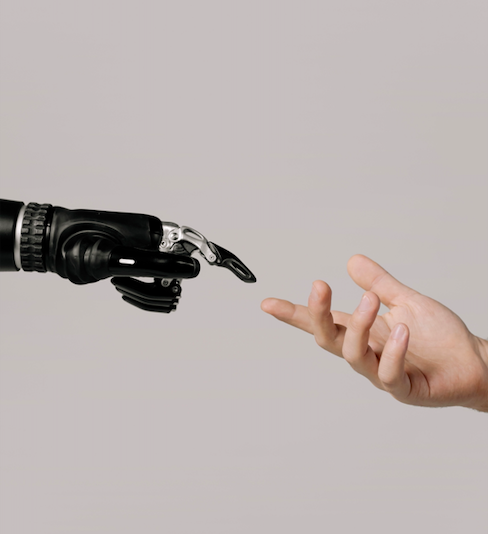
An AI can reflect. It can pattern-match. It can say the right thing at the right moment with increasing sophistication. What it cannot do, however, is carry you with it when the session ends. It won’t lose sleep over something you said. It processes, but it doesn’t feel the weight. And the weight — the sense that what you said landed in another person, that you mattered enough to affect someone — is part of what heals.
Connection isn’t a therapeutic technique. In many ways, it is the therapy.
The Misunderstood Middle Ground: Online Therapy
This is where the conversation often goes wrong.
Online therapy — sessions conducted via video with a qualified human therapist — tends to get bracketed with AI in the public imagination. It’s screen-based, it’s remote, and therefore it feels like a lesser version of the real thing.
The research says otherwise.
A 2024 meta-analysis in the journal Psychotherapy Research found no statistically significant difference in therapeutic alliance between videoconferencing psychotherapy and in-person therapy — as rated by both clients and therapists. Furthermore, a systematic review published in ScienceDirect found negligible differences in therapeutic outcomes across different treatment approaches and diagnosis types. In other words, the core mechanisms of good therapy translate reliably to video.
Clients in online sessions also report equivalent — and in some cases higher — levels of comfort disclosing difficult material. This may be because the slight distance of a screen reduces the intensity of face-to-face exposure, making it easier to say the harder things.
Online therapy, therefore, offers something AI cannot: a human being, qualified and present, who is genuinely in relationship with you across the session. It adds genuine accessibility — no commute, no waiting room, no geographic limitation — without sacrificing the human connection that actually drives change. Sessions from your own space, in your own language, regardless of where in the world you happen to be.
For international professionals, expats, and people navigating life across borders, this isn’t a compromise. It’s often the only realistic option for consistent, high-quality care in their first language. At PsyShrink, online therapy has allowed us to work with clients across continents — people who would otherwise have had no access to qualified English-language support.
So What Do We Actually Lose with AI?
If AI therapy continues to improve — and it will — the question isn’t whether it can simulate the appearance of understanding. It probably can, increasingly well.
The real question is whether simulation is enough. And the evidence suggests it isn’t — not for the kind of change that lasts.
What we lose with AI is the irreplaceable experience of mattering to someone. Of being held in mind by a person who chose this work, who brings their own humanity to the room, and who is genuinely affected by yours.
That’s not sentimentality. It’s what the research on human connection keeps returning to. We are regulated by each other. We are changed by each other. The healing in therapy has always been relational — and a relationship, by definition, requires two people.
AI has a role. It can reach people who would otherwise receive nothing. It can support between sessions. It can reduce stigma by making the first conversation feel lower-stakes. In that sense, it is a useful bridge.
But a bridge is not a destination.
The destination — for anyone who wants not just symptom management but genuine, lasting change — is still a human being. Available, qualified, present, and capable of being moved by you.
That’s what online therapy, at its best, delivers. And it’s what no algorithm, however sophisticated, has yet come close to replacing.
Cynthia Kunze is a senior psychologist and founder of PsyShrink, a multilingual therapy practice serving international professionals and expat families across Germany and online worldwide. She has 25 years of clinical experience working with individuals and couples